Reddit Market Research: How to Mine Threads for Customer Pain
How to read, collect and use what your buyers say on Reddit.
 Kalo Yankulov8 min readUpdated 10 Nov 2026
 Claude
 ChatGPT
 SensorhubBeginner

Reddit Market Research: How to Mine Threads for Customer Pain
Marketing
8 min read
How to read, collect and use what your buyers say on Reddit.
Written by Kalo Yankulov
Co-founder, Sensorhub
You have a positioning doc, three customer interviews collecting virtual dust in your Notion workspace, and a homepage headline that most team members cringe at. Meanwhile, your buyers describe the same problem in their own words, in public, every day.
That’s what Reddit is best at, before you write a single comment. It’s the largest collection of unprompted customer language you’ll ever get for free. Sorry, focus groups.

A warning before you copy any of it. Reddit shows you the people who post, and they are a loud minority. Use it to find the words and the complaints. Keep doing customer calls for everything else.
Reddit market research in three steps
Read the room. Learn how each community behaves before you log anything.
Collect the buyer’s words. Complaints, alternatives, questions, objections and pricing.
Compare it with what you claim. Hold what Reddit says next to your own website.
Do them in that order.

Step 1: Read the room
Ross Simmonds has the simplest way to read a subreddit. Sort a subreddit by Top → Past year and note three things: what gets upvoted, which pains keep coming back, and which tools get recommended.


Most CMOs have never spent 30 minutes inside r/Entrepreneur. That’s a mistake. There are 5.1 million members in that subreddit. 5.1 million people actively discussing: • customer acquisition • SaaS tools • agency experiences • AI workflows • pricing models • failures • pivots • growth experiments This isn’t noise. It’s live buyer psychology. r/Entrepreneur is one of the largest concentration points of founders on the internet, and many B2B brands selling into them have zero presence there. Here’s what smart operators understand: Reddit isn’t about posting. It’s about listening. Sort by “Top / Year.” Study what gets upvoted. Notice which tools are recommended without sponsorship. Pay attention to recurring pain patterns. That’s unfiltered market research at scale, and here’s the part most teams still underestimate: Those threads increasingly influence AI, generating answers. When someone asks an LLM about the “best CRM for founders” or “how to validate a SaaS idea,” Reddit citations frequently surface. Visibility inside r/Entrepreneur doesn’t just influence readers. It compounds discoverability across the AI layer of the internet. If you’re serious about modern B2B distribution, this is worth exploring → https://lnkd.in/gztibmdK Ignoring a community of 5 million entrepreneurs isn't a strategic focus. It’s a distribution blind spot.

Veruska Anconitano calls this lurking with purpose. You should come out of it knowing four things about a community:
Its unsolved problems.
Its misconceptions.
The formats that do well there.
The voices it trusts.
If something you write later doesn’t address one of those four, it wasn’t written for that community.
Tip: write those four things down where your drafts start. In Sensorhub that’s your Response Voice (Brand → Response Voices). If you draft somewhere else, add them to whatever context you give that tool. That way every draft starts from what the community cares about.
A trap to avoid: most founders “validate” on r/SaaS and r/microsaas. Those are full of other founders, not buyers. Other founders liking your idea doesn’t mean buyers will pay for it. You need to find industry-specific subreddits and research them for your ICP, so every question below is about your buyers. Not sure if I agree with the 99% below, but I do agree that you have to apply some critical thinking and get out of the room.

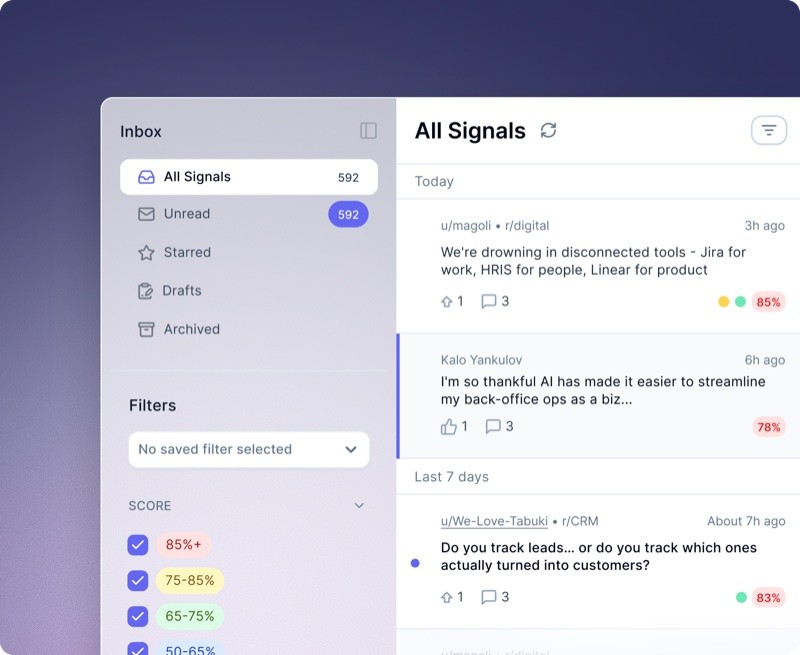
Open Brand → Subreddits. Sensorhub lists every community it monitors for your project, with how relevant each one is and how many signals it produced in the last 30 days.
Sort by Signals 30d and start reading in the top five. A signal in Sensorhub is an opportunity that was scored based on your brand context and buying intent.
For Encharge that's r/microsaas, r/saas, r/emailmarketing, r/growthhacking and r/entrepreneurs. Half an hour in each, sorted by Top for the past year, and you know the room.

How to read the room from Claude or ChatGPT with the Sensorhub MCP
The Sensorhub MCP gives Claude the same data, and Claude can read across it for you. Connect it once, then paste this prompt:
Calling SensorhubSensorhub scored 202 conversations for Encharge in the last 30 days.
Most active Reddit communities: r/microsaas (13), r/SaaS (13), r/Emailmarketing (8), r/Entrepreneurs (7), r/AskMarketing (6), r/GrowthHacking (6), r/hubspot (5), r/b2bmarketing (5). LinkedIn added 64 posts and X added 13.
Highest intent right now:
What they have in common: none of them is asking for an email tool. All three are founders who have traffic and sign-ups and can't turn them into paying users. That's an activation problem, which is what behaviour-based onboarding emails are for. The room is talking about conversion, not about email.
That last line is why you read the room first, before you post. Encharge sells email automation, and the people it should talk to don’t use the word email.
Step 2: Collect the buyer’s words
Five kinds of thread are worth logging:
Complaints about how people solve the problem today.
Alternatives. Requests for something to replace a named competitor.
Questions people ask before they buy.
Objections raised when someone recommends a tool like yours.
Pricing. What people think things should cost, and what they call expensive.
Copy the exact sentence each time. Read the replies/comments as well as the posts. In our data, two thirds of brand mentions in posts are neutral. In comments, a third are negative and a quarter are positive. So you can find more unfiltered opinions in the comments than in the posts.
A solopreneur on r/Solopreneur did only this. They stopped brainstorming, read complaint threads, and ended up with 680 paying users.
Now, bear in mind, we can’t always trust these anonymous, impossible-to-verify case studies, but nonetheless, this is a timeless strategy worth doing.

Why pricing gets its own bullet point
Emily Paxton at Obility points to a SurveyMonkey and Reddit survey: 45% of decision-makers who research on Reddit are looking for pricing. Her warning is that a stranger calling you expensive could become the opening anchor in your negotiation, and also a narrative LLM models cite.
I watched Claude research B2B software vendors over 12,000+ queries. When a vendor didn’t publish pricing, Claude didn’t skip it. It went to the competitors. 👀 Most B2B SaaS companies keep pricing behind a “Contact Sales” button. I understand why. Deals vary, sales wants room to negotiate, and nobody wants a competitor screenshotting the rate card. Here’s what happens instead, from Obility’s AI Search Footprint study: → 28% of Claude’s follow-ups discussed pricing → When pricing was missing, Claude filled the gap with competitor comparison pages and aggregators like VendorBenchmark and PricingNow → In Claude’s own words, guessing unpublished prices from memory would be “a plausible-sounding guess dressed up as market data” → Brands whose own pages showed up in the research were named in 89% of answers. Brands without them: 18%. Buyers outside the AI chat are doing the same thing. 45% of decision-makers researching on Reddit are looking for pricing (SurveyMonkey/Reddit, 2026). If they can’t find a number from you, “it’s expensive” from a stranger on Reddit becomes the starting point in your price negotiations. You don’t need to publish a full rate card. A few options that still give buyers (and AI Search) a ballpark: ✅ “Starts at” pricing ✅ A plain-language definition of your billing unit ✅ A cost estimate for a typical team size ✅ A list of what moves the price up or down ✅ A pricing FAQ written in plain text I wrote up the full data, Claude’s own explanations, and the pricing page fixes in my latest article.
Keyword alerts won’t get you there
Most guides tell you to set alerts for phrases like "looking for" and "anyone recommend". Liran Blumenberg did exactly that for a month. The result was 62,296 matches, of which 2.8% were real buying requests. The rest were job ads, sellers, spam and bots.

I set up alerts for "looking for" and "anyone recommend" across Reddit, X, LinkedIn, Nextdoor and Facebook groups. In a month: 62,296 matches. Only 2.8% were clear buying requests. The rest were lookalikes: 1. Hiring ads. "Looking for a plumber" was a job post, six times out of six. 2. Sellers asking questions. "Need a trusted local electrician?" is an ad. 3. The same spam, posted again and again. 4. Bots and digests. 5. Real buyers, of a chess book or a mousepad. The fix was simple and a little embarrassing: my phrases never named a service. "Anyone recommend" finds everything. "Anyone recommend a bookkeeper in Austin" finds buyers. The full breakdown and a 10-second check before you reply are in the article. What's the strangest "lead" your alerts ever sent you?
I’m with him on this. You need something that reads the post and analyzes it with AI, not a tool that simply matches an exact phrase. And, shameless plug, this is exactly what Sensorhub does. It analyzes millions of posts through LLM models and tags them accordingly.

Questions. Filter by the Community question tag and sort by Highest score. For Encharge, a marketing automation platform, that’s 2,655 Reddit threads, starting with people asking how to automate email workflows and which email tool to pick for SaaS. Bingo!

Pricing. Filter by Pricing discussion. For Encharge it returns 461 threads. Two near the top: someone in r/MailChimp saying it’s getting too expensive, and a founder asking whether HubSpot’s startup pricing is worth it past the MVP stage.

The exact sentence. Open any signal and click Post Preview. You get the thread as it appears on Reddit, with the mention highlighted, so you can copy the buyer’s words without leaving the page.

Look at that one closely. The person isn’t asking for features. They’re worried about slow support, and “simple and boring” is what they want. You can use those words on your homepage.
P.s. Look at the first reply too: a competitor dropping two aggressive links. That’s the reply you don’t want to write, and Chapter 4 covers what to write instead.
Step 3: Compare it with what you claim
Most people skip this one.
Here’s how Ross Simmonds does it. Search your category, your brand and your competitors with reddit on the end, then hold the pricing, onboarding and switching stories next to your own website. If Reddit says setup is painful and your homepage promises minutes, buyers have already noticed.
Google didn't fall in love with Reddit. It followed the users. People have been appending "reddit" to searches for years because they wanted answers that felt earned, not optimized. After the May 2026 core update, Reddit's No. 1 rankings jumped 54%. That's the B2B signal. Google is separating "needs expertise" from "needs experience." Your buyers need both. Run this check. Search your category, brand, and top competitors with "reddit" added. Look at pricing, onboarding, and switching stories. If Reddit says implementation is painful and your homepage says "launch in minutes," buyers are already noticing. Stop treating Reddit as a side channel. It's buyer research, reputation monitoring, and content strategy in one place.
Max Cordova’s shortcut is to Google [your brand] reddit and read the first five threads, because your prospects already have.
Google [your brand] reddit won’t be the only way to do this for long. Reddit just launched Reddit Reviews, AI-built product pages that sum up what people say in the comments, split into positive, negative and mixed. It covers about 10,000 products so far. A bad thread about you can end up in that summary.
Reddit Reviews, as Reddit shows it.
That’s why I think sentiment and perception tracking on Reddit is about to matter a lot more. My forecast: bots and spam flood Reddit in 2027, which makes real opinions harder to spot.
At Sensorhub we’ve built a feature called Claims, it’s part of our Brand Perception suite. It finds claims about your business that disagree with your website.
Watch your competitors’ customers
The most useful research threads are the ones where a competitor’s customer is unhappy in public. They tell you what the competitor gets wrong, in the customer’s words, and the person writing is often close to switching to an alternative.
Don’t stop at the titles, though. 7 in 10 brand mentions on Reddit are in a comment, not in the post. And Reddit is where people are most critical: 30% of brand mentions there are negative, against 15% on X and 7% on LinkedIn.
Mailchimp’s own subreddit filled with complaints after their pricing change, and no competitor showed up the last time we checked.
First, tell it who to watch. Open Setup → Watchlist and add your competitors. By default, we start tracking 15 of the most popular ones. It also suggests the ones mentioned most often in AI answers for your category, which is a quick way to find competitors you hadn't thought of.

Do you know all of your competitors?
You’re tracking fewer competitors than your buyers see when they research your category in AI models. We checked this in our own data. Across 31,551 AI answers from ChatGPT and Google AI Overviews, collected between 9 October and 3 November 2026 for 24 brands (728 prompts):

AI mentioned 5,417 other vendors our users weren’t tracking. That’s a median of 237 per brand.
It matches what buyers say. Kevin Indig went through Wynter’s survey of 200 software buyers: of the 158 who already had vendors in mind, 99 added another one to their shortlist through AI. That’s 63%.
So the competitors you’d list from memory are not the full set your buyers are comparing you with. Review the suggestions on the Watchlist before you start, or you’ll be watching complaint threads for the wrong companies.
Then filter for the complaints. In Signals, filter by the Competitor complaint tag and sort by Highest score.

For Encharge, that returns 171 Reddit threads. Here’s the top of the list:
r/StartupsHelpStartups: Mailchimp support tickets take weeks. Looking for alternatives.
r/CRMSoftware: HubSpot alternatives that don’t charge extra for every feature.
r/ShopifyeCommerce: a larger Shopify store that has outgrown Mailchimp.
r/b2bmarketing: a lean B2B team that wants a simpler CRM than Salesforce.
r/MailChimp: people rethinking Mailchimp after the free plan changes.
Read five of these and the same reasons keep coming up: slow support, paying per feature and outgrowing the product. Use them as your comparison page headings.
How to find why people leave a competitor with the Sensorhub MCP
Reading 171 threads is an afternoon. Claude can do the grouping for you through the Sensorhub MCP. Swap in your own competitor:
Calling SensorhubSensorhub has 48 Reddit threads where people ask for Mailchimp alternatives. Seven of the top eight score 75% or higher. The reasons, most common first:
- The price climbs as the list grows. One founder is about to pass 2,500 subscribers and expects another increase. Another has 8,000 contacts and feels they're overpaying. They want pricing that doesn't punish growth. (r/ecommerce, r/AskMarketing)
- Paying extra for every feature. A beginner says Mailchimp charges for each small thing. They want one plan with the basics included. (r/SaaS)
- Support. Tickets sit for weeks, and every send feels like a risk. They want something simple and reliable more than new features. (r/StartupsHelpStartups)
- Outgrowing the automation. A Shopify brand with a six-figure list and a company that wants to build email journeys both need more than newsletters. (r/ShopifyeCommerce, r/DigitalMarketing)
- Product changes. One thread is about Mailchimp discontinuing its Classic Automation Builder.
The oldest of these threads is from 2020 and the newest is from October 2026, so the price complaint is not new and has not gone away.
One prompt gave you the outline for a comparison page and five threads worth replying to.
Signals filters answer other questions you’d otherwise guess at.
• Before you set your pricing, search a competitor’s name plus “pricing”.
• Before a pricing page rewrite, filter by Pricing discussion.
• In the month before a launch, filter by Community question to see what people still don’t understand about your category.
When we tried this on Semrush, we found 9 active “looking to replace” threads in 30 days where the brand hadn’t replied.
Put it to work
Four places your Reddit market research goes:
Homepage. Add the top three complaints in the buyer’s words, each with your solution.
Your own claims. Fix the claims Reddit contradicts.
Comparison pages. Add one heading per reason for why people leave a competitor.
AI answers. People ask ChatGPT what they ask Reddit, so the questions you collected can become the prompts you track.
For the last one, open Setup → AI Search Prompts and add the questions. Sensorhub runs them on ChatGPT and Google AI Overviews every day and shows whether you, your competitors or Reddit get mentioned. You don’t have to keep the list fresh manually: every week Sensorhub suggests new prompts from real Reddit and community questions. Chapter 5 picks this up further, so stay tuned.

Do this this week